
As always, our firs few hours in Tomsk are a bit of a write-off. There are bags to put in storage, accommodations to find and stomachs to feed.
The search for a cheap place to stay takes longer than we expect. Students are coming back to university already, so the not-so-low-end rooms seem to be taken up by them. We check the resting rooms at the train station, the university hotel, a posh hotel and a medium-range hotel. In the end, we end up getting a room at the first place we checked out: the resting rooms at the train station are our best bet. Unlike Irkutsk, where the rooms were rented by the hour, the rooms here can be rented in blocks of time and the price for anything between 12 and 24 hours happens to be the same. This means we can unpack for a few days.
The ladies at the front desk are friendly and curious. They have foreigners stay at the resting rooms from time to time but they can’t talk to them.
“They don’t speak Russian, and we only speak Russian,” says Nina Stephanova, the dezhurnaya who checks us in. “There’s lots of talking with hands.” She demonstrates for us. “ ‘I’ [points to self] ‘want a room’ [hands draw a box] ‘to sleep’ [palms pressed together and placed under leaning head]. We used to have a dictionary and phrasebook, but somebody took it so we’re back to the old system.”
The women at the resting rooms are responsible for checking in guests, giving us hot water when we need some for food (porridge) or drink (tea), lending us the key to the pay-per-use showers, and generally answering any questions we have.
They also hold onto the room key whenever a guest leaves the resting rooms, and pass it back to us when we return. This, for us, seems to be often, as we always seem to be coming home from a walk around town or popping out to the nearest supermarket for food for breakfast/dinner in our room.
The other guests come and go, but it’s pretty quiet. We have a private room with two twin beds, but there are also dorm rooms with 3 to 4 beds. Some guests are waiting for their connecting train the next day, other seem to be sleeping off a heavy day/night of drinking, many are doing both. Still, the ladies at the desk are on duty 24/7 and don’t put up with any nonsense from the guests, so the place is quiet and clean and the only time we notice our neighbours is when the shared bathrooms are all occupied or when we pass each other in the hall, towels draped over our shoulders or grocery bags in our hands.
On Day 289 we have a chance to actually visit Tomsk rather than simply walk through it in search of a place to sleep. We originally decided to come to Tomsk because it sounded charming, and we’re happy that the city lives up to its reputation. Even the train station area is clean and well-organized, rather than the industrial wasteland on the edge of the city. All trains and buses seem to lead to the train station, so we catch a tram downtown to visit the few streets in town that still have the old wooden buildings that Tomsk is famous for. The ornate window shutters and window frames remind us of Ulan Ude, but are much more varied and better-tended than the ones we saw there.
The second day, we take a day trip to a nearby village that the guidebook recommends as a trip to a real Siberian village. The standing-room only local bus drops us off in the village of Kolarova at around 11 am, and it only takes us 15 minutes or so to walk most of the streets in town and to realize that Arshan is a tough act to follow as far as Siberian villages go, so we decide to catch the 11:45 minivan back to town. A woman at the “bus stop” (roadside outside a tiny shop) is selling a bucket of fresh baby cucumbers and a bunch of dill – enough, I assume, to make a healthy set of pickles. I ask her if it’s possible to buy just one or two cucumbers. We’re hungry and could use a snack to keep us happy until we get lunch back in town.
“Buy one?” she says, and hands me two. “Just have some. Wash them first.”
I give them a quick rinse under the faucet of a hand-pump just outside the store. We thank her, flag down the minivan and eat the cucumbers on the ride back to town.
The weather outside is generally warmish and fairly dry, so we catch trams to the center of town and walk around most days. We drop by the art museum and walk over to the WWII memorial in a park. It’s a towering statue of a mother (Mother Russia, I assume) handing her son a rifle. Music plays from loudspeakers near the rows and rows of granite memorial that list the names of locals who died. My memory of deathrates for Canadian soldiers in WWII is a little sketchy, but Russia’s death rates from that time always seem particularly high to me. Tomsk is not a large city, and of the roughly 20,000 soldiers that left the town to fight, less than half returned.
The memorial is a popular spot, surrounded by green grass and a glade of trees, and is near a scenic viewpoint. Photographers trail after brides (“Hey, look, another slutty wedding dress,” Pierre says from time to time) as they hunt down the next great shot. New moms take a few minutes to read a book on a park bench while their babies sleep next to them in their strollers and prams.
We also visit the NKVD Oppression Museum, which documents the late 1930s, which sound to be some of the worst years of life under Stalin. The museum is located in the cells where political prisoners were held and interrogated. In the hall, there are photos displayed of a sampling of people from Tomsk who were singled out. The descriptions are brief. Poet. Academic. Priest. Arrested on this date. Executed on that date.
Each of the four cells contains different exhibits: photos from the time period, explanations of how the rules of detention worked, photos of the gulags where people were sent to do hard labour.
The front desk doubles as a kiosk, where one woman reads a book in between selling the occasional ticket and handing back change. She barely looks up when we hand her our rubles. Her colleague, a slight woman in her late 40s, is much more animated and walks the floor of the museum answering questions for visitors. After we’ve walked around for a few minutes, she approaches us to see if we have any questions and notices my open dictionary and the notepad I’m scribbling in.
She says something I don’t entirely catch, a question as to whether I’m looking up words I don’t know. When I say yes she gives me a warm hug.
Russians are not generally a huggy people, at least not with strangers, so the hug is odd and entirely unexpected. Still, I appreciate her enthusiasm for the Russian language and her job, so I give her a quick hug back. She spends the rest of our visit going out of her way to explain exhibits to Pierre and I and to share anecdotes and facts.
On one wall, we see a collection of photos, much like a yearbook montage of the headshots of that year’s graduates.
“Tower guards,” she says, and then points to a nearby photo of a tower at the border of a gulag. “Once we had a visitor who recognized her father as one of these guards.” She points to his face on the montage. “She'd always believed that he’d been one of the oppressed too, he’d always said so, but it turned out he’d been on the other side.”
At another exhibit, she explains the rules of arrest. “If a married man was arrested, his wife could avoid arrest by divorcing him. If she didn’t, she’d be arrested too.” She also explains the rules about the children of the arrested, but I only slightly understand. I believe she says that kids under 3 were not arrested, kids 3 to 15 went to the gulags but lived in the nursery there, while any kids over 15 were arrested as adults along with their parents. “It was very easy to be accused. You could be arrested for just talking to the wrong person. Let’s say the three of us were in the same place at the same time, a museum like now, and we talked for a moment about one of the exhibits and then went our separate ways. If you turned out later to be accused, I could be brought in for talking to you, and interrogated about what we had plotted during our conversation.”
We pass through all the rooms, pass the exhibit of the administrator’s desk, and past the cell with wooden bunks where prisoners slept.
“Do you find this a sad place to work?” I ask her.
She doesn’t. She explains that one of her family members was held here – an uncle, I believe – and who most likely died in the gulag or was shot. “When I’m here, I feel like I’m close to him.”
On Day 291, we have to register our passports, which the train station is unable to do for us. (The current visa laws say that you can only stay a maximum of 3 days in a new city before registering your passport with the authorities, and you have to either stay at an institution that’s capable of registering the passport or with a Russian who’s willing to do the paperwork to register you. So we pack up and leave the resting rooms at the train station to go to the Sputnik hotel, the medium-range hotel we had checked out earlier in the week.
The original price we were quoted for a room seemed quite high, but once it turned out that we didn’t need to have the breakfast and that we were fine with a king size bed instead of twin beds, the price dropped by about 25 percent. We’re not quite sure why a king size bed is drastically cheaper than a room with two twins, but we don’t feel like arguing. We enjoy a night of free showers and a tv in the room, which allows us to watch Japanese anime dubbed into Russian. On day 292, we pack up again an catch the 11:08 am train to Vladimir.
Tuesday, October 13, 2009

Days 282 to 283 – Tue Aug 11 to Wed Aug 12 –Arshan, Arshan…
Day 282 gets off to a late and creaky start. We talk to the landlord about extending our stay with him in Arshan. To do this, we explain, we need to register our visas.
The latest Russian visa rules state that foreign tourists must register themselves if they plan to stay in one town for more than 3 days - registering involves paperwork and having a local vouch for you as their guest. Danil's wife, Larisa, kindly agrees to register us, a process which ends up spreading out over 3 hours as we hunt down the appropriate forms and a working photocopier, and wait for businesses to re-open after their lunch hours and work breaks are done.
Arshal has a population of about 1000 residents (but more in summer) so infrastructure and services are limited. There's one main street that runs through town - the highway - and it ends where the trails to the mountains begin. We don't find any place during our stay with Internet and don't see any public phones.
We relax in town on 282, and by Day 283, Pierre's eager to get out again though I'm still not too enthusiastic about the idea of a hike. My feet and legs hurt, and I'm still a little irritated with the mountain. Pierre suggests a short hike so I pack a few apples and some bread. I notice Pierre packing 3 litres of water and wonder if our ideas of a "short" walk are quite different.
I join the walk on the understanding that I'll turn back if I get tired - more tired than I already am. This will let me get back to the room and get some work done at home. I want to study a bit, maybe write a few blogs out by hand in a little notebook. I have lists and lists of Russian words and phrases that I've been learning/remembering for the past few days and I know that if I don't review them and copy them into my study book then I'll forget them all. These words and phrases are tools we need for getting around everyday so they're important to me.
The beginning of the hike starts in the shady woods - it's a bit steep and dry, and it feels like we're up near the end of the tree line.


 Around the time I'm ready to turn back down the mountain, we run into a group of students hiking up the mountain. One of them, Julia (sounds like Yulia), strikes up a conversation with us in English and introduces us to her friends Christina, Nikita and Sasha.

 We talk about music, and school, and as the trail gets steeper and dustier, they teach us the trick of taking rests by leaning backs against the trees, facing up towards the top of the mountain. We use this trick a lot.

The trail becomes much more challenging than I or my tired body had bargained for. Julia and her friends keep assuring me that the peak is just 20 or 30 minutes away, but the "just a few minutes" and "just over the hills" keep adding up until, before I know it, we've been hiking, almost straight up for almost 4 hours.


Finally, about 30 minutes from the actual top of the mountain I sit down and enjoy the view and let Pierre keep going. Our group of hikers is a bit scattered by now. The boys have gone on a side trail to find some water in a nearby river and the girls continue on to the top. There are storm clouds in the distance...

...so when Pierre returns we head straight down.
"The top really was only 30 minutes away," he says.
But I don't care. I'm happy to be hiking down and off the mountain, though my knees are still sore from our long walk down on Day 281. After 2 hours of walking down hill, we reach Arshan again. By this time, even Pierre is pretty sated and not in a hurry to go for a big hike. We agree that this will really really be our last big hike together in Arshan (though Pierre is welcome to go alone since the trails are so busy and well marked).
As we arrive back at our little cottage, the storm we saw in the distance finally arrives and the wind picks up. After dinner in a snackshop, on the way back to our place, we get caught in a small duststorm on main street. We walk into some stinging nettles (which really do sting) and get home and settled in just as the rain starts (and just as the nettles stop stinging). The wind does its best to shake the walls of the cottage, and just as we are debating whether or not to turn out the lights, the power goes out. The entire town is dark.
Problem solved: we go to sleep. I try to dream about anything but hiking and wonder if I'll get time to work tomorrow.
Photo credits: All images in this post courtesy of the lovely and amazing Christina S!

The latest Russian visa rules state that foreign tourists must register themselves if they plan to stay in one town for more than 3 days - registering involves paperwork and having a local vouch for you as their guest. Danil's wife, Larisa, kindly agrees to register us, a process which ends up spreading out over 3 hours as we hunt down the appropriate forms and a working photocopier, and wait for businesses to re-open after their lunch hours and work breaks are done.
Arshal has a population of about 1000 residents (but more in summer) so infrastructure and services are limited. There's one main street that runs through town - the highway - and it ends where the trails to the mountains begin. We don't find any place during our stay with Internet and don't see any public phones.
We relax in town on 282, and by Day 283, Pierre's eager to get out again though I'm still not too enthusiastic about the idea of a hike. My feet and legs hurt, and I'm still a little irritated with the mountain. Pierre suggests a short hike so I pack a few apples and some bread. I notice Pierre packing 3 litres of water and wonder if our ideas of a "short" walk are quite different.
I join the walk on the understanding that I'll turn back if I get tired - more tired than I already am. This will let me get back to the room and get some work done at home. I want to study a bit, maybe write a few blogs out by hand in a little notebook. I have lists and lists of Russian words and phrases that I've been learning/remembering for the past few days and I know that if I don't review them and copy them into my study book then I'll forget them all. These words and phrases are tools we need for getting around everyday so they're important to me.
The beginning of the hike starts in the shady woods - it's a bit steep and dry, and it feels like we're up near the end of the tree line.


 Around the time I'm ready to turn back down the mountain, we run into a group of students hiking up the mountain. One of them, Julia (sounds like Yulia), strikes up a conversation with us in English and introduces us to her friends Christina, Nikita and Sasha.
 We talk about music, and school, and as the trail gets steeper and dustier, they teach us the trick of taking rests by leaning backs against the trees, facing up towards the top of the mountain. We use this trick a lot.
The trail becomes much more challenging than I or my tired body had bargained for. Julia and her friends keep assuring me that the peak is just 20 or 30 minutes away, but the "just a few minutes" and "just over the hills" keep adding up until, before I know it, we've been hiking, almost straight up for almost 4 hours.


Finally, about 30 minutes from the actual top of the mountain I sit down and enjoy the view and let Pierre keep going. Our group of hikers is a bit scattered by now. The boys have gone on a side trail to find some water in a nearby river and the girls continue on to the top. There are storm clouds in the distance...

...so when Pierre returns we head straight down.
"The top really was only 30 minutes away," he says.
But I don't care. I'm happy to be hiking down and off the mountain, though my knees are still sore from our long walk down on Day 281. After 2 hours of walking down hill, we reach Arshan again. By this time, even Pierre is pretty sated and not in a hurry to go for a big hike. We agree that this will really really be our last big hike together in Arshan (though Pierre is welcome to go alone since the trails are so busy and well marked).
As we arrive back at our little cottage, the storm we saw in the distance finally arrives and the wind picks up. After dinner in a snackshop, on the way back to our place, we get caught in a small duststorm on main street. We walk into some stinging nettles (which really do sting) and get home and settled in just as the rain starts (and just as the nettles stop stinging). The wind does its best to shake the walls of the cottage, and just as we are debating whether or not to turn out the lights, the power goes out. The entire town is dark.
Problem solved: we go to sleep. I try to dream about anything but hiking and wonder if I'll get time to work tomorrow.
Photo credits: All images in this post courtesy of the lovely and amazing Christina S!

Days 284 to 285 – Thurs Aug 13 to Fri Aug 14 – …and more Arshan
We wake up to a rainy, mellow Arshan on Thursday. The air temperature in the valley better matches that of the incoming airstream this morning, so the winds have died down. The electricity is still out from the night before - we open the curtains for light, have a cold snack of pepperoni and bread and put on an extra layer of clothes to keep warm. When we cross the yard to the outhouse we can see our breath. Danil knocks a short while later and starts a fire for us in the whitewashed woodstove in the corner of our bedroom. This lets us boil a little water to cook breakfast, and make something warm to drink from the mountain water that we collect from the sink next to the banya and carry into our kitchen by the bucket.
For the first time in at least a week, I'm able to to sit down at a table and work. I transcribe some of my hasty language notes from the past few days into my study notebook, and look in the dictionary for some key terms I'm lacking. Pierre plays some guitar. The sound carries out into the yard, and Danil drops in for a few minutes to listen. He sits and plays us a Mongolian ballad. He tells us he hasn't played the guitar in about 15 years, but after a few minutes his fingers remember their way around the strings just fine.
Later, we pass him in the yard cooking some shashleek (shish kebobs) on an outdoor wood grill, and he talks hockey with us. The game between Canada and the Soviet Union in the 70s (1972?) is still a strong memory for him - especially how the Soviets lost. "But then Canada came and played here, and we won that time." I tell him that during a hockey strike a few years ago, CBC Canada played old games from the 70s to make up th dead airtime, so we've actually seen a few clips of those games.
"No helmets," he days, "and long hair. The more scars you had, the more money you earned." He mentions how shocked the Soviet commentators were by the fighting between players during the game with Canada, how they said "this sort of thing doesn't belong in hockey."
"Russians don't fight when they play hockey?"
"Rarely," he says. "It's not the norm."
Shashleek, he tells us, is a Mongolian word. Shash means 'thing' and leek means 'on a stick'. Ghenghis Khan's troops would cook their meat while travelling across the steppes, with the meat stuck on their swords and cooked over an open fire.
Even later that night, Danil drops by with a bottle of vodka, two-thirds empty, and visits with us at our kitchen table for about an hour or so. He talks to us about Mongolian history and culture, and I do my best to keep up with his words and to pass on the gist of things to Pierre. Also, in my haste to be a hostess of sorts, I commit the faux pas of pouring the vodka into glasses.
Danil stares at me for a moment, as though I've just emptied the bottle down the sink. He clears his throat. "Women never pour liquor," he explains. This, it turns out, is a Mongolian/Buryat thing. "They don't drink either. They sit at the table and don't talk. Talking and drinking is for men."
His words are much more gentle and polite in person than on paper, and I'm more than happy to not have to drink.
Danil still has family living in Mongolia, just below the border that runs east-west a short drive south of where we are. They are separated from each other by the randomness of country borders. By the time the bottle empties, he's talked his way through colonization and life under the communists, and has sung a few acappella Mongolian songs. The electricity comes back on halfway through his second song. When he and Pierre empty the bottle, he offers to go and get another.
"I can drink two of these myself," he says. I believe him, but it can't be very easy on his 50/60 year old body, even if he does only do it on special occasions. (They have friends visiting today).
"He wants to get a second bottle," I tell Pierre. "I'm going to tell him no. My head is sore from translating, it's late and I feel like a bag of hammers."
"OK," says Pierre, and he turns to Danil. "Thank you very much, that's very generous but I will hold off for tonight. I like the vodka, and I can drink more,but it's late and we should get to bed."
Danil looks to me for translation. I know that if I tell him what Pierre said, it won't make sense to him, and he'll see it as an invitation to good-naturedly harangue him into drinking more. If we tell him I'm tired, I know that it really really won't matter to him and he'll just get a second bottle.
"Pierre says thank you," I say to Danil, "but vodka makes him very tired. He cannot drink like you. He thinks it is time for bed."
Danil laughs and pats Pierre on the shoulder. Danil seems happy to have more tolerance than the young'un, while Pierre's is glad that Danil takes the refusal so well. I don't bother to explain - I'm just happy to be getting to bed. Being in charge of the conversation has its perks.
We don't see Danil at all the next day, doing any of his normal chores, so we assume he must have a considerable hangover.
The cottage is still very cold on Day 285 - we do our laundry by hand and hang it out to dry on the clothes line. Danil's wife, Larissa, drops in and starts us another fire. It starts to drizzle - we bring the laundry back in and drape it over whatever is handy: the metal bed frames, the kitchen table benches and the strings that hold up the curtains. We walk down the main street, eat at a snack shop and buy tickets for the next day's minivan trip to Irkutsk. When the sky clears up, we walk to the nearby datsan, a tiny Buddhist temple near the edge of town.
The temple is different from what we remember from Thailand and Cambodia, and the style, we're told, is much closer to the Tibetan style of Buddhist temple. There's a building with a colourful room and altar. There are two small stupas that people walk around, following the direction of the sun in the sky. We poke rubles into the prayer wheel and spin it the requisite number of times.
We walk back into town, and decide to make one last stop at the mineral water fountain and enjoy the ribbon trees.
Arshan is a kind of resort town, known for its mineral waters. We go most days to enjoy the free, naturally carbonated water, and bring a bottle or two home for drinking. The tub the water taps drain into are red with rust from the natural minerals in the water, and the water itself runs clear when it first pours into a bottle, but by the second day it starts to take on a reddish tinge. People travel a long way to drink the Arshan water, to bathe in hot springs, to breathe in the healthy mountain air, and to generally hike, rest and heal.
Nearby are trees covered in strips of ribbon and cloth tied to their branches as a kind of prayer flag, another sign of the Tibetan-Buddhism so prevalent in town and in this part of the country. The ribbons are linked to the healing waters, and seems to play a part in the healing process for the people who come here, no matter how young or old.
On our walk home, drink mineral water from our bottle and notice a sign for a performer coming to the local bar. The poster promises music in Buryat, Russian, Mongolian and Turkish. From the photo, the looks like it has the potential to be slightly new-agey - a dark eyed man with long black hair is photoshopped next to the head of a wolf - but we decide to try it anyway.
The show, however, is much more fun than the poster implies, and the whole event reminds me of a wedding at the local Legion. Groups of friends sit around small formica top tables, and sip beer while they wait for the show to start. Quick bartenders zag back and forth behind the bar, like printheads on old dot-matrix printers. A pair of multi-coloured disco balls light up the ceiling near the stage and a smoke machine chuffs out a bit of atmosphere every so often.
When the music starts, the singer kicks off with a few slower ballads set to synth music. The long hair from the poster has been tamed down into a tidy mullet. The first song is in Mongolian, the second in Buryat - his pitch is perfect and the songs are very catchy. When the singer takes a 15 minute break to rest his voice, the crowd dances to Russian disco from the 70s and Russian pop from the 80s. After the break, the signer keeps the pace and crowd going with (what I assume are) some Russian favourites, all set to a danceable beat. He has a cordless microphone and is able to walk down the aisle of tables, past the neon lit bar fridges to serenade tables, often just in from a smoke break and ordering a few more sundaes for the children at the table.
The show starts at 10, and by 11:30 we head home, the crowd still dancing and singing. There are no street lights in the town, so we find our way down the bumpy sidewalk with the help of the headlights of the occasional car that drives past.
For the first time in at least a week, I'm able to to sit down at a table and work. I transcribe some of my hasty language notes from the past few days into my study notebook, and look in the dictionary for some key terms I'm lacking. Pierre plays some guitar. The sound carries out into the yard, and Danil drops in for a few minutes to listen. He sits and plays us a Mongolian ballad. He tells us he hasn't played the guitar in about 15 years, but after a few minutes his fingers remember their way around the strings just fine.
Later, we pass him in the yard cooking some shashleek (shish kebobs) on an outdoor wood grill, and he talks hockey with us. The game between Canada and the Soviet Union in the 70s (1972?) is still a strong memory for him - especially how the Soviets lost. "But then Canada came and played here, and we won that time." I tell him that during a hockey strike a few years ago, CBC Canada played old games from the 70s to make up th dead airtime, so we've actually seen a few clips of those games.
"No helmets," he days, "and long hair. The more scars you had, the more money you earned." He mentions how shocked the Soviet commentators were by the fighting between players during the game with Canada, how they said "this sort of thing doesn't belong in hockey."
"Russians don't fight when they play hockey?"
"Rarely," he says. "It's not the norm."
Shashleek, he tells us, is a Mongolian word. Shash means 'thing' and leek means 'on a stick'. Ghenghis Khan's troops would cook their meat while travelling across the steppes, with the meat stuck on their swords and cooked over an open fire.
Even later that night, Danil drops by with a bottle of vodka, two-thirds empty, and visits with us at our kitchen table for about an hour or so. He talks to us about Mongolian history and culture, and I do my best to keep up with his words and to pass on the gist of things to Pierre. Also, in my haste to be a hostess of sorts, I commit the faux pas of pouring the vodka into glasses.
Danil stares at me for a moment, as though I've just emptied the bottle down the sink. He clears his throat. "Women never pour liquor," he explains. This, it turns out, is a Mongolian/Buryat thing. "They don't drink either. They sit at the table and don't talk. Talking and drinking is for men."
His words are much more gentle and polite in person than on paper, and I'm more than happy to not have to drink.
Danil still has family living in Mongolia, just below the border that runs east-west a short drive south of where we are. They are separated from each other by the randomness of country borders. By the time the bottle empties, he's talked his way through colonization and life under the communists, and has sung a few acappella Mongolian songs. The electricity comes back on halfway through his second song. When he and Pierre empty the bottle, he offers to go and get another.
"I can drink two of these myself," he says. I believe him, but it can't be very easy on his 50/60 year old body, even if he does only do it on special occasions. (They have friends visiting today).
"He wants to get a second bottle," I tell Pierre. "I'm going to tell him no. My head is sore from translating, it's late and I feel like a bag of hammers."
"OK," says Pierre, and he turns to Danil. "Thank you very much, that's very generous but I will hold off for tonight. I like the vodka, and I can drink more,but it's late and we should get to bed."
Danil looks to me for translation. I know that if I tell him what Pierre said, it won't make sense to him, and he'll see it as an invitation to good-naturedly harangue him into drinking more. If we tell him I'm tired, I know that it really really won't matter to him and he'll just get a second bottle.
"Pierre says thank you," I say to Danil, "but vodka makes him very tired. He cannot drink like you. He thinks it is time for bed."
Danil laughs and pats Pierre on the shoulder. Danil seems happy to have more tolerance than the young'un, while Pierre's is glad that Danil takes the refusal so well. I don't bother to explain - I'm just happy to be getting to bed. Being in charge of the conversation has its perks.
We don't see Danil at all the next day, doing any of his normal chores, so we assume he must have a considerable hangover.
The cottage is still very cold on Day 285 - we do our laundry by hand and hang it out to dry on the clothes line. Danil's wife, Larissa, drops in and starts us another fire. It starts to drizzle - we bring the laundry back in and drape it over whatever is handy: the metal bed frames, the kitchen table benches and the strings that hold up the curtains. We walk down the main street, eat at a snack shop and buy tickets for the next day's minivan trip to Irkutsk. When the sky clears up, we walk to the nearby datsan, a tiny Buddhist temple near the edge of town.
The temple is different from what we remember from Thailand and Cambodia, and the style, we're told, is much closer to the Tibetan style of Buddhist temple. There's a building with a colourful room and altar. There are two small stupas that people walk around, following the direction of the sun in the sky. We poke rubles into the prayer wheel and spin it the requisite number of times.
We walk back into town, and decide to make one last stop at the mineral water fountain and enjoy the ribbon trees.
Arshan is a kind of resort town, known for its mineral waters. We go most days to enjoy the free, naturally carbonated water, and bring a bottle or two home for drinking. The tub the water taps drain into are red with rust from the natural minerals in the water, and the water itself runs clear when it first pours into a bottle, but by the second day it starts to take on a reddish tinge. People travel a long way to drink the Arshan water, to bathe in hot springs, to breathe in the healthy mountain air, and to generally hike, rest and heal.
Nearby are trees covered in strips of ribbon and cloth tied to their branches as a kind of prayer flag, another sign of the Tibetan-Buddhism so prevalent in town and in this part of the country. The ribbons are linked to the healing waters, and seems to play a part in the healing process for the people who come here, no matter how young or old.
On our walk home, drink mineral water from our bottle and notice a sign for a performer coming to the local bar. The poster promises music in Buryat, Russian, Mongolian and Turkish. From the photo, the looks like it has the potential to be slightly new-agey - a dark eyed man with long black hair is photoshopped next to the head of a wolf - but we decide to try it anyway.
The show, however, is much more fun than the poster implies, and the whole event reminds me of a wedding at the local Legion. Groups of friends sit around small formica top tables, and sip beer while they wait for the show to start. Quick bartenders zag back and forth behind the bar, like printheads on old dot-matrix printers. A pair of multi-coloured disco balls light up the ceiling near the stage and a smoke machine chuffs out a bit of atmosphere every so often.
When the music starts, the singer kicks off with a few slower ballads set to synth music. The long hair from the poster has been tamed down into a tidy mullet. The first song is in Mongolian, the second in Buryat - his pitch is perfect and the songs are very catchy. When the singer takes a 15 minute break to rest his voice, the crowd dances to Russian disco from the 70s and Russian pop from the 80s. After the break, the signer keeps the pace and crowd going with (what I assume are) some Russian favourites, all set to a danceable beat. He has a cordless microphone and is able to walk down the aisle of tables, past the neon lit bar fridges to serenade tables, often just in from a smoke break and ordering a few more sundaes for the children at the table.
The show starts at 10, and by 11:30 we head home, the crowd still dancing and singing. There are no street lights in the town, so we find our way down the bumpy sidewalk with the help of the headlights of the occasional car that drives past.
Days 286 to 288 – Sat Aug 15 to Mon Aug 17 – Arshan -> Irkutsk -> Tomsk
On Day 286, we spend a few last hours in Arshan before we say goodbye to our hosts. The bus to Irkutsk is actually a small van (a marshrutka), with assigned seating, like the one we took from Ulan Ude to Arshan. We have, as always, our two big backpacks, our two small backpacks, Pierre's guitar and a grocery bag of snacks for the road. At first, all of this luggage makes our cramped seat in the back right hand corner seem like a terrible idea. I take a stab at getting different seats but the seats, I'm told, are sold out and we'll just have to make due.
However, when the van leaves the first stop it's short of a few people, and by its last stop in town there are still three free seats left. Everyone spreads out a bit and Pierre gets a seat with a bit more leg room while his guitar tucks in nicely next to our seats.
A few hours later the marshrutka drops us off at the Irkutsk train station. Our plan is to stay at one of the "resting rooms" available at the train station since they're the best deal in town and will let us avoid lugging our bags somewhere tonight only to have to bring them back in the morning to catch our train. As always, the prices for the rooms are significantly higher than those listed in our guide book, but we bargain to stay in a room from 9pm to 7am to save a few (hundred) rubles. We have a few hours to wait until we can get our room and we need Internet, so I leave Pierre with the bags and go searching. The Internet club across from the station has no connection when I drop by.
"But you usually do have a connection?" I ask, just to clarify.
"Usually, yes. Right now it's not working."
I'm not clear if this means the whole town's connection is down or not, so I catch a tram into town to try locate a few of the Internet cafes listed in the guide book. I check address after address over the course of the next two hours, but none of the places listed seem to exist anymore. I see no clearly marked hostels, and when I ask passers by about Internet, they think for a moment and then shrug. Hmm, good question. By the time I meet up with Pierre again at the train station, I'm very glad that we didn't bother devoting more than one night to Irkutsk.
We head upstairs to the resting rooms where at 8:59 we see the door to our room open and the previous tenants - a married couple with a small child - exit the room with their luggage to catch their train. The front desk clerk escorts us into a small room with two twin beds in the center and two cribs along one wall. We put our new sheets on the bed and unpack just enough for the night. The ceiling is about 15 feet high, while the room is maybe 12 feet wide. The windows look down onto the track and when we open the windows for air, we can hear the trains pass, and the loudspeakers announce departures and arrivals. When we close the windows, the sounds are blocked out almost entirely, and we sleep soundly.
Our train leaves at 10:06 Irkutsk time - our cabin mates for part of the trip are Pavel and his daughter Katya, just back from a family trip to Moscow ("Very expensive") and St. Petersburg ("Less expensive, but still very expensive") and another woman, whose name we never learn. We have the top bunks and when the train starts we take a moment to make our beds and settle in. The train stops every few hours for 20 to 30 minutes, and we get off to walk around, buy snacks, take pictures, and look at the old steam engines that are set up as monuments.
We eat, sleep, drink hot water and read. The train arrives in Tomsk 30 hours after leaving Irkutsk at 3:35 pm Tomsk time.
However, when the van leaves the first stop it's short of a few people, and by its last stop in town there are still three free seats left. Everyone spreads out a bit and Pierre gets a seat with a bit more leg room while his guitar tucks in nicely next to our seats.
A few hours later the marshrutka drops us off at the Irkutsk train station. Our plan is to stay at one of the "resting rooms" available at the train station since they're the best deal in town and will let us avoid lugging our bags somewhere tonight only to have to bring them back in the morning to catch our train. As always, the prices for the rooms are significantly higher than those listed in our guide book, but we bargain to stay in a room from 9pm to 7am to save a few (hundred) rubles. We have a few hours to wait until we can get our room and we need Internet, so I leave Pierre with the bags and go searching. The Internet club across from the station has no connection when I drop by.
"But you usually do have a connection?" I ask, just to clarify.
"Usually, yes. Right now it's not working."
I'm not clear if this means the whole town's connection is down or not, so I catch a tram into town to try locate a few of the Internet cafes listed in the guide book. I check address after address over the course of the next two hours, but none of the places listed seem to exist anymore. I see no clearly marked hostels, and when I ask passers by about Internet, they think for a moment and then shrug. Hmm, good question. By the time I meet up with Pierre again at the train station, I'm very glad that we didn't bother devoting more than one night to Irkutsk.
We head upstairs to the resting rooms where at 8:59 we see the door to our room open and the previous tenants - a married couple with a small child - exit the room with their luggage to catch their train. The front desk clerk escorts us into a small room with two twin beds in the center and two cribs along one wall. We put our new sheets on the bed and unpack just enough for the night. The ceiling is about 15 feet high, while the room is maybe 12 feet wide. The windows look down onto the track and when we open the windows for air, we can hear the trains pass, and the loudspeakers announce departures and arrivals. When we close the windows, the sounds are blocked out almost entirely, and we sleep soundly.
Our train leaves at 10:06 Irkutsk time - our cabin mates for part of the trip are Pavel and his daughter Katya, just back from a family trip to Moscow ("Very expensive") and St. Petersburg ("Less expensive, but still very expensive") and another woman, whose name we never learn. We have the top bunks and when the train starts we take a moment to make our beds and settle in. The train stops every few hours for 20 to 30 minutes, and we get off to walk around, buy snacks, take pictures, and look at the old steam engines that are set up as monuments.
We eat, sleep, drink hot water and read. The train arrives in Tomsk 30 hours after leaving Irkutsk at 3:35 pm Tomsk time.
Friday, October 9, 2009
Day 281 - Monday Aug 10 - The long long walk
Our day begins at 5:45 am - we get up, make breakfast and organize before meeting our guide, Igor, for our hike.
We originally meet Igor on Day 281 through our guidebook, which gives directions to a nearby hostel that's popular with mountain climbers. We head there looking for trail maps but when we arrive, we discover that all that's left of the hostel are the burnt foundations. There was a fire in December, he tells us, and since then he and his girlfriend and their pets have been living on the grounds of the hostel, alternating between a tent (summer) and a mongolian ger (winter). He's philosophical about the loss of the building: "It's more important that everyone got out all right." Their set up is rustic but cozy and neat. Wildflowers are knee-high. A line of laundry hangs next to the fence that surrounds the property.
Our original plan - to simply pick up a map and find a few trails ourselves - changes drastically when we ask Igor this hypothetical question: "What kind of treks can be done in a day?" Igor traces it on our map: up one mountain to a lake above the tree line, then up and over into the mountain valley before heading back down, past a few waterfalls, to Arshan. He estimates it would take at least 10 hours, depending on the speed we hike.
And so our walk officially begins at 7:15 am. The first part of the trip is fairly gentle and we pass rivers and small waterfalls as we work our way up through the forest. Igor is just as much of a camera fanatic as Pierre is, and when he's not taking pictures he's enjoying the view (as he waits for us). The forest looks a lot like the forests we've seen in western Canada, only it feels bigger, somehow, and it has spiders that bite. Igor walks with a stick held up in front of him as though he's holding a flag in a parade. This, he explains, is to break the spider webs across the trail.
"If you break a web and a spider lands on you, it's better to do this" he says, and mimics picking up a spider gently from his neck, like a delicate berry, "rather than this." He mimics swatting his neck. "If you do that, it will bite you. You won't get sick but you won't feel very comfortable either." We let Igor keep the lead and leave him in charge of spider (re)location.


We keep a steady pace with only a few breaks to drink water and rest our legs, and it's almost noon by the time we finally get up past the tree line and stop for lunch on the shore of the lake.
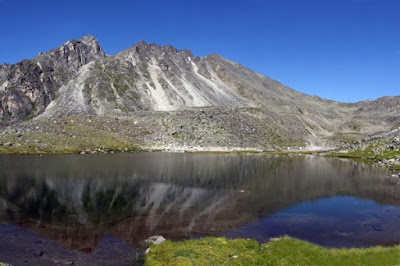


Igor shares with us some of the local meat that he's brought with him and we share with him some of our dried fruit. During a stop to refill his water bottle in the lake, Pierre slips and soaks his feet. While planned dips in mountain lakes are generally better than unplanned, Pierre takes it pretty well, with only a bit of colorful accompanying language and some wry chuckles as he wrings out his socks and squeezes what water he can out of his shoes. After lunch, we head up to the ridge that leads into the mountain valley.


We stop there for about 30 minutes. Pierre would have stayed all day. The view is absolutely breathtaking. A crystal clear sky shining on a horseshoe shaped valley that opens out onto mountains as far as you can see on the horizon. The mountain meadow's lush green colour is dotted with spots of wildflowers and a few orange tents. A little river runs down one side of it and becomes a waterfall that we will see later on. It's hard to tear yourself away from that kind of splendor, but perhaps the experience is all the more precious for being brief. So we make our way down the lip of the bowl and Igor shows us how to hold our weight on the steep slope by digging our walking sticks into the loose stone and leaning onto them.


In the valley is a Russian yogi and a group of people joining her on her yoga retreat. Igor tells us that the yogi spends July to December of every year in this valley meditating (and doing yoga, I suppose). It's a lovely spot but full of blackflies - their legs and arms are covered with bites. I admire the group for putting up with the bugs. I, in my thoroughly un-zen state, spend the duration of our time in the valley rocking my walking stick back and forth in front of my body to keep the bugs from landing on me. The yogi and her friends don't swat at the bugs once.
A few of the yogi's guests are leaving today and they join us for the walk down. Veronica and Sergei have been in the mountain valley for two weeks.
"What do you eat up here?" I ask Veronica as we start walking down.
"Kasha," she says: buckwheat porridge. "Twice a day." Later on, they're both enthusiastic about a snack of dried fruit, bread and mutton that Pierre, Igor and I pool together during a break.
After a quick side trip to a waterfall (Igor tells us: "exclusive". Apparently not everyone gets to see this one, and we tend to agree as the scramble down the side of the cliff is pretty hairy at times) in a lower part of the valley, Igor finally leads us down the mountain towards town. The route is beautiful and the weather is great, but by about hour 10 of the walk, Pierre and I are pretty tired.
Unfortunately, we still have several more hours of walking to go before we can stop. By hour 11, I confuse being tired of walking with being tired of the mountain. By hour 12, I resent the mountain. There is swearing, mostly in my head.
The entire descent form the valley and at least 80% of our route is along rocky river banks which require a lot of clambering and balancing. As Pierre learned earlier, his shoes don't do well on wet rocky terrain and so he treads carefully. In combination with the fatigue, we're slower than we should be. We pass more waterfalls, stop for tea at a tent site with a friend of Igor's, do a few river crossings over some slippery logs and makeshift bridges and then pass more waterfalls. By the time we arrive back in town at around 8:30 pm, Pierre and I are both worn out. In total, we've walked some 24 kilometers. The sky is still light thanks to the long northern summer days - we visit with Igor for awhile in his yard, then head to a snack shop for a late dinner of borsch and meatballs and stumble home to bed.


The verdict: a beautiful, beautiful hike that I have no desire to repeat for a long, long time.
Photo credits: A big thanks to Igor for sending us the pictures that he took that day!
We originally meet Igor on Day 281 through our guidebook, which gives directions to a nearby hostel that's popular with mountain climbers. We head there looking for trail maps but when we arrive, we discover that all that's left of the hostel are the burnt foundations. There was a fire in December, he tells us, and since then he and his girlfriend and their pets have been living on the grounds of the hostel, alternating between a tent (summer) and a mongolian ger (winter). He's philosophical about the loss of the building: "It's more important that everyone got out all right." Their set up is rustic but cozy and neat. Wildflowers are knee-high. A line of laundry hangs next to the fence that surrounds the property.
Our original plan - to simply pick up a map and find a few trails ourselves - changes drastically when we ask Igor this hypothetical question: "What kind of treks can be done in a day?" Igor traces it on our map: up one mountain to a lake above the tree line, then up and over into the mountain valley before heading back down, past a few waterfalls, to Arshan. He estimates it would take at least 10 hours, depending on the speed we hike.
And so our walk officially begins at 7:15 am. The first part of the trip is fairly gentle and we pass rivers and small waterfalls as we work our way up through the forest. Igor is just as much of a camera fanatic as Pierre is, and when he's not taking pictures he's enjoying the view (as he waits for us). The forest looks a lot like the forests we've seen in western Canada, only it feels bigger, somehow, and it has spiders that bite. Igor walks with a stick held up in front of him as though he's holding a flag in a parade. This, he explains, is to break the spider webs across the trail.
"If you break a web and a spider lands on you, it's better to do this" he says, and mimics picking up a spider gently from his neck, like a delicate berry, "rather than this." He mimics swatting his neck. "If you do that, it will bite you. You won't get sick but you won't feel very comfortable either." We let Igor keep the lead and leave him in charge of spider (re)location.


We keep a steady pace with only a few breaks to drink water and rest our legs, and it's almost noon by the time we finally get up past the tree line and stop for lunch on the shore of the lake.


Igor shares with us some of the local meat that he's brought with him and we share with him some of our dried fruit. During a stop to refill his water bottle in the lake, Pierre slips and soaks his feet. While planned dips in mountain lakes are generally better than unplanned, Pierre takes it pretty well, with only a bit of colorful accompanying language and some wry chuckles as he wrings out his socks and squeezes what water he can out of his shoes. After lunch, we head up to the ridge that leads into the mountain valley.


We stop there for about 30 minutes. Pierre would have stayed all day. The view is absolutely breathtaking. A crystal clear sky shining on a horseshoe shaped valley that opens out onto mountains as far as you can see on the horizon. The mountain meadow's lush green colour is dotted with spots of wildflowers and a few orange tents. A little river runs down one side of it and becomes a waterfall that we will see later on. It's hard to tear yourself away from that kind of splendor, but perhaps the experience is all the more precious for being brief. So we make our way down the lip of the bowl and Igor shows us how to hold our weight on the steep slope by digging our walking sticks into the loose stone and leaning onto them.


In the valley is a Russian yogi and a group of people joining her on her yoga retreat. Igor tells us that the yogi spends July to December of every year in this valley meditating (and doing yoga, I suppose). It's a lovely spot but full of blackflies - their legs and arms are covered with bites. I admire the group for putting up with the bugs. I, in my thoroughly un-zen state, spend the duration of our time in the valley rocking my walking stick back and forth in front of my body to keep the bugs from landing on me. The yogi and her friends don't swat at the bugs once.
A few of the yogi's guests are leaving today and they join us for the walk down. Veronica and Sergei have been in the mountain valley for two weeks.
"What do you eat up here?" I ask Veronica as we start walking down.
"Kasha," she says: buckwheat porridge. "Twice a day." Later on, they're both enthusiastic about a snack of dried fruit, bread and mutton that Pierre, Igor and I pool together during a break.
After a quick side trip to a waterfall (Igor tells us: "exclusive". Apparently not everyone gets to see this one, and we tend to agree as the scramble down the side of the cliff is pretty hairy at times) in a lower part of the valley, Igor finally leads us down the mountain towards town. The route is beautiful and the weather is great, but by about hour 10 of the walk, Pierre and I are pretty tired.
Unfortunately, we still have several more hours of walking to go before we can stop. By hour 11, I confuse being tired of walking with being tired of the mountain. By hour 12, I resent the mountain. There is swearing, mostly in my head.
The entire descent form the valley and at least 80% of our route is along rocky river banks which require a lot of clambering and balancing. As Pierre learned earlier, his shoes don't do well on wet rocky terrain and so he treads carefully. In combination with the fatigue, we're slower than we should be. We pass more waterfalls, stop for tea at a tent site with a friend of Igor's, do a few river crossings over some slippery logs and makeshift bridges and then pass more waterfalls. By the time we arrive back in town at around 8:30 pm, Pierre and I are both worn out. In total, we've walked some 24 kilometers. The sky is still light thanks to the long northern summer days - we visit with Igor for awhile in his yard, then head to a snack shop for a late dinner of borsch and meatballs and stumble home to bed.
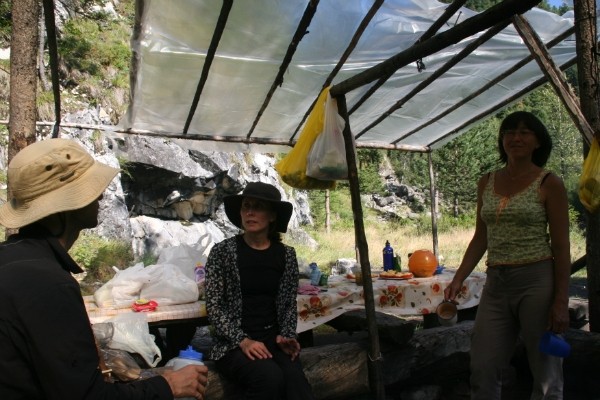

The verdict: a beautiful, beautiful hike that I have no desire to repeat for a long, long time.
Photo credits: A big thanks to Igor for sending us the pictures that he took that day!
Thursday, October 8, 2009
Day 280 - Sun Aug 9 - Ulan Ude to Arshan
From the previous day's research, we know that there are mini-vans that run daily from the Ulan Ude train station to the village of Arshan, our next destination. These mini-vans leave every hour between 8:00 am and 10:00 pm, and only depart once every seat is filled. It's an eight hour ride, about 12$ per person, and seats are on a first-come-first-served basis.
Originally, we plan to catch the 8:00 am, but when we reach the city bus stop near our hotel it seems the buses run rarely on weekend mornings. Our backpacks, etc, very clearly mark us out as tourists, and a Buryat men waiting at the bus stop strikes up a conversation with us. He and his friends are local boys, from villages in the area, living in town and working on construction sites. They like the town and enjoy having the area's famous Tibetan Buddhist temple (datsan) nearby where they can go on their more spiritual days.
Today is their day off and they're up early, hoping to continue the party from the night before. "We're not drunks," he explains, "we're just having a good time." He just wants to clarify that they're in a different category from the full-time drinkers so common in town - those with the leathery skin, bleary eyes, staggering pace and sharp odour of chronic drinkers. "If you have hands and feet you should work," he says, and does not think very highly of those who ask for change for their drinks rather than working for it.
Pierre and I wait for our bus and talk with our new friend awhile until we finally realize we realize the bus we want may not come in time. We negotiate with a taxi driver and say goodbye to our worker friend. As we put our bags away, he continues to chat away, and I miss most of it but catch the gist at the end: "Is there anyway you could spot us 100 rubles?"
I see the logic in this: Pierre and I have enough money to spend on a 100 ruble taxi ride to the train station, so perhaps we've got an extra 100 (4$) lying around taking up space. I think up a way to say no that won't sound to him as though I'm turning down a panhandler. "Sorry," I say. "We only have enough for the taxi and bus."
He smiles his goodnatured smile - oh well, worth a shot - says good luck and wanders back to his friends at the bus stop.
At the station, there's no sign of the mini-van yet, so Pierre waits in the station out of the drizzle with our bags while I hover around the parking space where the 9:00 am Arshan bus should arrive sometime before the hour. A small crowd of passengers eventually gathers.
When the mini-van finally arrives, there's a scramble for seats. As expected, there's shoving and I get a few elbow jabs, but in the end the fight for seats is pretty tame as far as transportation scrums go. I wiggle my way far enough into the side door to throw my back pack and one grocery bag into a pair of seats. Voila, we have a reservation. Pierre staggers over with our remaining bags - we tuck one next to the driver, another under the back seat, wedge our small backpacks and grocery bags aound our calves and rest Pierre's guitar on his lap. Crowded, but fairly cosy. The ride goes smoothly for the first 7 hours of the trip.
Though the sign in the minivan window says "ARSHAN" our bus driver doesn't plan on going all the way there. Instead of taking the turn to Arshan, the driver tells a group of us to get out. This kind of change of plan is pretty familiar to us by this point in the trip - getting from A to B is always less straightforward than we expect. Still, I'm not clear on why we need to get out.
I turn to another woman exiting the minivan - she also looks a little confused. "Do we continue by foot?" I ask her. She and her friend laugh like I've just made a witty joke. Apparently, no, we won't continue on foot.
We wait at the road side "bus stop" with our mini-van driver for about 10 minutes until a bus passes by. The minivan driver talks to the bus driver, and they seem to negotiate a passenger swap. This allows the mini-van driver to continue to the next and final town without making the detour to Arshan, and the bus driver only has to go to Arshan without continuing on to the next town. We lug all of our things onto the bus for the 20 minute ride to Arshan.
The stops off at a little bus hut near a park and we pile off again with our many bags. I take a few moments to load myself up and when I look up I notice Pierre looking at a loss. An elderly man is lying on the ground on the curb next to the bus. From the way his wife calmly sits down her bag and lies down on the ground next to him to talk , I assume that he's on the ground by choice. She is sober, he is not. From his tone of voice I assume he's refusing to go anywhere after the bus ride. We offer to give a hand and Pierre manages to help the man and his wife as far as the grass a few feet away before the man gets cranky again and doesn't want any help. His wife laughs.
"We'll sit on the grass awhile," she says to us. "Where are you from?" I tell her. She lowers her husband onto the grass. "We have lots of drunks here in Buryatia," she says and laughs again.
"In Canada, too," I say. No one around us seems to be taking much notice of the public-fall-down-drunkenness at 4:00 pm. It reminds me of Ulan Ude. I ask her for direction to the Arshan Spa, where we think we might find accommodations, and she poins us down the street.
As we walk down the street, we pass fences and houses, most of which have little signs that say "zhilyo" (жилье). This means more or less "lodgings available." The guidebook mentions these and says they are quite a good deal, but we continue onto the Arshan Spa. It's not quite what we expected, in terms of price or appearance, and the lady at the front desk is a mix of multiple front desk cliches from Hollywood movies: bulldog expression, bleached blonde bun high on her head. She grudgingly gives us the price information and a registration form. Pierre and I debate the price and the type of room we're likely to get. In the end, we decide to check out a zhilyo before committing to a room here. Not an extensive search - just one or two.
The first place I check out isn't willing to take two people for just two or three days, so I check out lodgings at the house next door. The building and yard are unassuming by Russian standards, but neat - wood fence, wood house, woodpile in the yard. I wander in the front gate and the owner, Danil, comes out to give me a quick tour of the rooms he has for offer.
The first room is simple and dark, with cots and a hotplate, but the second is much more charming. The place feels like a cottage - the front door leads into a small bright kitchen area with a sink, hotplate, fridge and table; a second door leads into the sleeping area. There I find four cots and a couch, a TV and a whitewashed woodstove.
I love the place but with all the hiking we're hoping to do, I know we're both looking for a place where we can take a shower from time to time. I have no problem with using the nearby outhouse, but I have no desire to take cold water sink showers for the next few days.
"Do you have a shower?" I ask.
"Well, we have a banya," he says. I recognize the word, but I have never had a chance to use a banya myself, the Russian sauna/washing room that is such a part of Russian culture.
"Are we allowed to use it?" I ask, just to clarify.
He gives me a funny "of course" look. "Just tell me an hour before you need it and I'll start the stove."
Danil takes me across the yard and shows me the two by two metre wooden shack with a white water tank above a woodstove. He shows me the lightswitch and where the door locks for privacy, explains how to pull hot water from the heated tank and how to mix it with the cold mountain water from the tap on the wall. There are basins and metal scoops for collecting the water and pouring it out again.
I go to collect Pierre and our bags and we walk back to Danil's place, past the cows that as always are loose in town, trimming the grass that lines the roadside and near the parks.
Pierre's impressed with our little cottage and thrilled about the banya. Since there are so many cots and couches in our place we expect that we might get roommates at some point, but it turns out that the place is all ours for only 24$CAN per night. We like our little home the nearby mountains so much that we decide to skip visiting Lake Baikal and instead stay in Arshan until Day 286 when we catch our train to Tomsk.
We celebrate our first night with a trip to the banya and a bowl of borscht from a local snack shop. We meet with a local guide to set up a long day hike on Day 281 before heading home to sleep.
Originally, we plan to catch the 8:00 am, but when we reach the city bus stop near our hotel it seems the buses run rarely on weekend mornings. Our backpacks, etc, very clearly mark us out as tourists, and a Buryat men waiting at the bus stop strikes up a conversation with us. He and his friends are local boys, from villages in the area, living in town and working on construction sites. They like the town and enjoy having the area's famous Tibetan Buddhist temple (datsan) nearby where they can go on their more spiritual days.
Today is their day off and they're up early, hoping to continue the party from the night before. "We're not drunks," he explains, "we're just having a good time." He just wants to clarify that they're in a different category from the full-time drinkers so common in town - those with the leathery skin, bleary eyes, staggering pace and sharp odour of chronic drinkers. "If you have hands and feet you should work," he says, and does not think very highly of those who ask for change for their drinks rather than working for it.
Pierre and I wait for our bus and talk with our new friend awhile until we finally realize we realize the bus we want may not come in time. We negotiate with a taxi driver and say goodbye to our worker friend. As we put our bags away, he continues to chat away, and I miss most of it but catch the gist at the end: "Is there anyway you could spot us 100 rubles?"
I see the logic in this: Pierre and I have enough money to spend on a 100 ruble taxi ride to the train station, so perhaps we've got an extra 100 (4$) lying around taking up space. I think up a way to say no that won't sound to him as though I'm turning down a panhandler. "Sorry," I say. "We only have enough for the taxi and bus."
He smiles his goodnatured smile - oh well, worth a shot - says good luck and wanders back to his friends at the bus stop.
At the station, there's no sign of the mini-van yet, so Pierre waits in the station out of the drizzle with our bags while I hover around the parking space where the 9:00 am Arshan bus should arrive sometime before the hour. A small crowd of passengers eventually gathers.
When the mini-van finally arrives, there's a scramble for seats. As expected, there's shoving and I get a few elbow jabs, but in the end the fight for seats is pretty tame as far as transportation scrums go. I wiggle my way far enough into the side door to throw my back pack and one grocery bag into a pair of seats. Voila, we have a reservation. Pierre staggers over with our remaining bags - we tuck one next to the driver, another under the back seat, wedge our small backpacks and grocery bags aound our calves and rest Pierre's guitar on his lap. Crowded, but fairly cosy. The ride goes smoothly for the first 7 hours of the trip.
Though the sign in the minivan window says "ARSHAN" our bus driver doesn't plan on going all the way there. Instead of taking the turn to Arshan, the driver tells a group of us to get out. This kind of change of plan is pretty familiar to us by this point in the trip - getting from A to B is always less straightforward than we expect. Still, I'm not clear on why we need to get out.
I turn to another woman exiting the minivan - she also looks a little confused. "Do we continue by foot?" I ask her. She and her friend laugh like I've just made a witty joke. Apparently, no, we won't continue on foot.
We wait at the road side "bus stop" with our mini-van driver for about 10 minutes until a bus passes by. The minivan driver talks to the bus driver, and they seem to negotiate a passenger swap. This allows the mini-van driver to continue to the next and final town without making the detour to Arshan, and the bus driver only has to go to Arshan without continuing on to the next town. We lug all of our things onto the bus for the 20 minute ride to Arshan.
The stops off at a little bus hut near a park and we pile off again with our many bags. I take a few moments to load myself up and when I look up I notice Pierre looking at a loss. An elderly man is lying on the ground on the curb next to the bus. From the way his wife calmly sits down her bag and lies down on the ground next to him to talk , I assume that he's on the ground by choice. She is sober, he is not. From his tone of voice I assume he's refusing to go anywhere after the bus ride. We offer to give a hand and Pierre manages to help the man and his wife as far as the grass a few feet away before the man gets cranky again and doesn't want any help. His wife laughs.
"We'll sit on the grass awhile," she says to us. "Where are you from?" I tell her. She lowers her husband onto the grass. "We have lots of drunks here in Buryatia," she says and laughs again.
"In Canada, too," I say. No one around us seems to be taking much notice of the public-fall-down-drunkenness at 4:00 pm. It reminds me of Ulan Ude. I ask her for direction to the Arshan Spa, where we think we might find accommodations, and she poins us down the street.
As we walk down the street, we pass fences and houses, most of which have little signs that say "zhilyo" (жилье). This means more or less "lodgings available." The guidebook mentions these and says they are quite a good deal, but we continue onto the Arshan Spa. It's not quite what we expected, in terms of price or appearance, and the lady at the front desk is a mix of multiple front desk cliches from Hollywood movies: bulldog expression, bleached blonde bun high on her head. She grudgingly gives us the price information and a registration form. Pierre and I debate the price and the type of room we're likely to get. In the end, we decide to check out a zhilyo before committing to a room here. Not an extensive search - just one or two.
The first place I check out isn't willing to take two people for just two or three days, so I check out lodgings at the house next door. The building and yard are unassuming by Russian standards, but neat - wood fence, wood house, woodpile in the yard. I wander in the front gate and the owner, Danil, comes out to give me a quick tour of the rooms he has for offer.
The first room is simple and dark, with cots and a hotplate, but the second is much more charming. The place feels like a cottage - the front door leads into a small bright kitchen area with a sink, hotplate, fridge and table; a second door leads into the sleeping area. There I find four cots and a couch, a TV and a whitewashed woodstove.
I love the place but with all the hiking we're hoping to do, I know we're both looking for a place where we can take a shower from time to time. I have no problem with using the nearby outhouse, but I have no desire to take cold water sink showers for the next few days.
"Do you have a shower?" I ask.
"Well, we have a banya," he says. I recognize the word, but I have never had a chance to use a banya myself, the Russian sauna/washing room that is such a part of Russian culture.
"Are we allowed to use it?" I ask, just to clarify.
He gives me a funny "of course" look. "Just tell me an hour before you need it and I'll start the stove."
Danil takes me across the yard and shows me the two by two metre wooden shack with a white water tank above a woodstove. He shows me the lightswitch and where the door locks for privacy, explains how to pull hot water from the heated tank and how to mix it with the cold mountain water from the tap on the wall. There are basins and metal scoops for collecting the water and pouring it out again.
I go to collect Pierre and our bags and we walk back to Danil's place, past the cows that as always are loose in town, trimming the grass that lines the roadside and near the parks.
Pierre's impressed with our little cottage and thrilled about the banya. Since there are so many cots and couches in our place we expect that we might get roommates at some point, but it turns out that the place is all ours for only 24$CAN per night. We like our little home the nearby mountains so much that we decide to skip visiting Lake Baikal and instead stay in Arshan until Day 286 when we catch our train to Tomsk.
We celebrate our first night with a trip to the banya and a bowl of borscht from a local snack shop. We meet with a local guide to set up a long day hike on Day 281 before heading home to sleep.
Days 278 to 279 - Fri Aug 7 to Sat Aug 9 - Ulan Ude
The train pulls into our station around 7:30 am, and we step off the train with our four backpacks, a guitar, a scooter and the remaining grocery bag of food. The signs in the train station are in cyrillic, the same as in Mongolia, but this time the words make sense to me. Toilets. Magazines. Left Luggage Room. Exit to City.
We have no plan for our first few hours in Russia and no place to stay, so we leave our bags at the left luggage office and wander downtown. As always, the area around the train station is pretty grim - warehouses, overhead wires, rundown brick buildings, and not much of a pedestrian area. It doesn't feel dangerous at this time of day, merely neglected, and after a 15 minute walk we reach the town's more scenic main square, which is actually a rectangle. At one side is Ulan Ude's former pride: the world's largest Lenin's head. We stop to get a photo.
"I think they're pretty safe with that record now," says Pierre: not too many new Lenin heads going up anymore. Ulan Ude's version is slightly cross-eyed and is big enough to dwarf an adult. The locals who pass by us on the sidewalk barely notice it.
The hotels in town are busy today, though we don't see many tourists around, and the prices are generally 50 to 70% higher than the guidebook suggests. We hope this isn't a hint of what we're to expect price-wise in the rest of Russia. In the end, we settle on a fairly central, fairly cheap hotel in the southwest part of town, near an outdoor market. The room is on a half-renovated floor. When we walk to the communal toilet (not yet renovated) at the end of the hall, we pass by the older rooms, airing out after their cleanings. The white walls are chipped and graying. In contrast, our room is neat and freshly painted with a sink in one corner. From our window, we can see down towards the market, and down onto the streetside kiosks that sell cigarettes, beer and hot snacks. The pay showers (thankfully, renovated) are down the hall and for 2.50$ CAN per person you get all the hot water you can stand once the water finally works its way from the basement up to the third floor.
The key to the shower is held by the floor monitor/concierge that the Russians call a dezhurnaya/дежурная (from the French term de jour?). She is also our main source for boiled water and new towels. By the front door there is a guard reading a paper who registers us in his guest log the first time we head out into the city.
The center of Ulan Ude is small and a bit run down, but still beautiful and very different from what we've seen in the rest of Asia. Many of the older residential buildings are made of dark stained wood planks with carved wooden lattices framing the windows. The foundations of most buildings are no longer level, with many buildings either tipping down into the dirt on one end or warping in the middle near the sidewalks. We wander around for a few hours before deciding to find something to eat.
We decide to head into a "zakusuchnaya" (закусочная). The word is on signs almost every few houses in our part of the city - the word doesn't ring a bell from my first trip but I know it translates into something like "snack shop." We head into one one of them - a small gate in the fence leads to a short mud path that leads into what looks like someone's private kitchen. At first I'm not sure if we're in the right place.
We poke our heads in and I ask a passing woman "Can we?"
She nods. "Of course, of course," and waves us through to the dining room. The room is painted robin's egg blue from ceiling to floor, with plastic blue table cloths over mismatched tables. Some tables have benches, others have wooden chairs. A fly strip hangs in the middle of the room. From a menu taped to the table by the cash I order us two bowls of beef noodle soup. When we take a seat we discover that each meal also comes with all the fresh baked bread you can handle.
We wander out again. At one point, while Pierre is (re)taking a photo, I go into a grocery store to kill time. When I meet up with him again I show him our travel buddy for the day: a round loaf of bread that works out to about 40 cents. It's roughly the size of a cantaloupe. We have a bite and instantly realize that it's been 10 months since our last real loaf of bread. Fresh whole wheat bread. Pierre is glowing.
Later on the same street, while Pierre is taking a photo, a man pops his head out of a window - he's heard us speaking English and is curious. "Where are you from?" We tell him and he leans onto the window sill and makes himself comfortable. His name is Victor, he looks to be in about his 50s or 60s, and used to work as a school teacher. The building he leaning out of at the moment is under renovation - we're not quite clear on what he's doing there or if he's one of the workers. He talks a bit about his background (Buryat), the building's history (someone famous lived in it once) and Princess Diana (because of my name). Another worker passes by and says something to him - it seems to be his signal to go back to work. He says goodbye and disappears back into the building. Later on we pass him again on the street and chat again for a few minutes.
Day 279 is rainy, so we make a few trips to the store for supplies and explore another corner of our neighbourhood. Nearby is a Russian Orthodox church where we are treated to the first onion domes of our trip.
The rain falls sporadically and the streets are still flooded with last night's rainfall. We make running jumps over puddles to make it dry to the other side. One of Pierre's jumps meets a slippery end, so we make a pit stop to patch up his scraped hand with disinfectant and bandaids. We head to a nearby pharmacy to replenish our supply of portable swabs of rubbing alcohol.
At the pharmacy we enter into a situation which is common of the next weeks of our trip: myself and my dictionary acting the role of interpreter/communicator for our little group of two. To Pierre, it is as though the Russian version of Shakespeare is flowing from my lips. In reality, it's often more like this:
Functional, yes - it's gets us the swabs we need - but not much finesse.
We have no plan for our first few hours in Russia and no place to stay, so we leave our bags at the left luggage office and wander downtown. As always, the area around the train station is pretty grim - warehouses, overhead wires, rundown brick buildings, and not much of a pedestrian area. It doesn't feel dangerous at this time of day, merely neglected, and after a 15 minute walk we reach the town's more scenic main square, which is actually a rectangle. At one side is Ulan Ude's former pride: the world's largest Lenin's head. We stop to get a photo.
"I think they're pretty safe with that record now," says Pierre: not too many new Lenin heads going up anymore. Ulan Ude's version is slightly cross-eyed and is big enough to dwarf an adult. The locals who pass by us on the sidewalk barely notice it.
The hotels in town are busy today, though we don't see many tourists around, and the prices are generally 50 to 70% higher than the guidebook suggests. We hope this isn't a hint of what we're to expect price-wise in the rest of Russia. In the end, we settle on a fairly central, fairly cheap hotel in the southwest part of town, near an outdoor market. The room is on a half-renovated floor. When we walk to the communal toilet (not yet renovated) at the end of the hall, we pass by the older rooms, airing out after their cleanings. The white walls are chipped and graying. In contrast, our room is neat and freshly painted with a sink in one corner. From our window, we can see down towards the market, and down onto the streetside kiosks that sell cigarettes, beer and hot snacks. The pay showers (thankfully, renovated) are down the hall and for 2.50$ CAN per person you get all the hot water you can stand once the water finally works its way from the basement up to the third floor.
The key to the shower is held by the floor monitor/concierge that the Russians call a dezhurnaya/дежурная (from the French term de jour?). She is also our main source for boiled water and new towels. By the front door there is a guard reading a paper who registers us in his guest log the first time we head out into the city.
The center of Ulan Ude is small and a bit run down, but still beautiful and very different from what we've seen in the rest of Asia. Many of the older residential buildings are made of dark stained wood planks with carved wooden lattices framing the windows. The foundations of most buildings are no longer level, with many buildings either tipping down into the dirt on one end or warping in the middle near the sidewalks. We wander around for a few hours before deciding to find something to eat.
We decide to head into a "zakusuchnaya" (закусочная). The word is on signs almost every few houses in our part of the city - the word doesn't ring a bell from my first trip but I know it translates into something like "snack shop." We head into one one of them - a small gate in the fence leads to a short mud path that leads into what looks like someone's private kitchen. At first I'm not sure if we're in the right place.
We poke our heads in and I ask a passing woman "Can we?"
She nods. "Of course, of course," and waves us through to the dining room. The room is painted robin's egg blue from ceiling to floor, with plastic blue table cloths over mismatched tables. Some tables have benches, others have wooden chairs. A fly strip hangs in the middle of the room. From a menu taped to the table by the cash I order us two bowls of beef noodle soup. When we take a seat we discover that each meal also comes with all the fresh baked bread you can handle.
We wander out again. At one point, while Pierre is (re)taking a photo, I go into a grocery store to kill time. When I meet up with him again I show him our travel buddy for the day: a round loaf of bread that works out to about 40 cents. It's roughly the size of a cantaloupe. We have a bite and instantly realize that it's been 10 months since our last real loaf of bread. Fresh whole wheat bread. Pierre is glowing.
Later on the same street, while Pierre is taking a photo, a man pops his head out of a window - he's heard us speaking English and is curious. "Where are you from?" We tell him and he leans onto the window sill and makes himself comfortable. His name is Victor, he looks to be in about his 50s or 60s, and used to work as a school teacher. The building he leaning out of at the moment is under renovation - we're not quite clear on what he's doing there or if he's one of the workers. He talks a bit about his background (Buryat), the building's history (someone famous lived in it once) and Princess Diana (because of my name). Another worker passes by and says something to him - it seems to be his signal to go back to work. He says goodbye and disappears back into the building. Later on we pass him again on the street and chat again for a few minutes.
Day 279 is rainy, so we make a few trips to the store for supplies and explore another corner of our neighbourhood. Nearby is a Russian Orthodox church where we are treated to the first onion domes of our trip.
The rain falls sporadically and the streets are still flooded with last night's rainfall. We make running jumps over puddles to make it dry to the other side. One of Pierre's jumps meets a slippery end, so we make a pit stop to patch up his scraped hand with disinfectant and bandaids. We head to a nearby pharmacy to replenish our supply of portable swabs of rubbing alcohol.
At the pharmacy we enter into a situation which is common of the next weeks of our trip: myself and my dictionary acting the role of interpreter/communicator for our little group of two. To Pierre, it is as though the Russian version of Shakespeare is flowing from my lips. In reality, it's often more like this:
"Hello. Please help us. I do not know the name of the thing we seek. It is small and square and when you have a hurt, you can open and do this [mime wiping wound] to clean. Do you know this thing? Do you have them?"
Functional, yes - it's gets us the swabs we need - but not much finesse.
Subscribe to:
Posts (Atom)
